

How To Use Drawing View Toon Boom
Everyone has a story to tell, and blitheness is one of the many awesome mediums to do just that. Animation allows you to create scenes directly from your imagination! And then throughout this tutorial, we will be learning to create an animated scene in Toon Boom.
1. Get to Know Toon Boom
Pace 1
Create a new scene by filling out these boxes upon opening the plan:
(1) Proper noun: Name your scene here.
(ii) Location: Indicate where you want to salvage the file of your scene by clicking Browse...
(3) Camera Size: You tin can select a default camera size from here, or you can customize your settings by entering your preferred values in the boxes for Width, Height, Frame Rate, and Field of View
(four) Create Scene: You may click this button in one case all of the above are set.


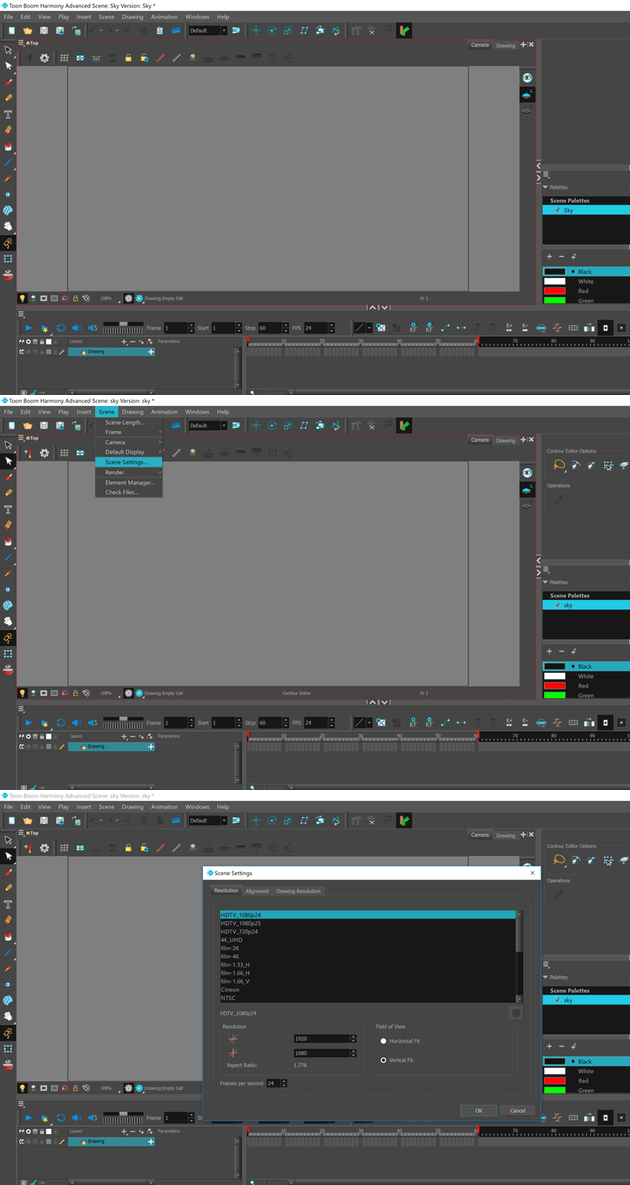
In case y'all decide to change your settings after you've created your scene, you can easily do and so past clicking Scene > Scene Settings. Hither yous tin can suit your Resolution and Frames per second.


Footstep 2
Familiarize yourself with the interface.
The following are the more essential parts that nosotros will be using often in this tutorial.
(one) Camera view: This is the drawing surface area. Discover that there is a rectangle inside the gray infinite; this is the size of the camera and basically the phase where the animation takes place. Anything outside the borders will non show upwards in rendered outputs.
(2) Timeline: This is where we create and alter layers and frames, and edit the length of the animation.
(3) Toolbar: All our essential tools, which volition be listed ane past ane later, are constitute hither.
(four) Tool Properties: This is where y'all can customize your tool's backdrop and/or settings (if bachelor).
(5) Color Palette: This is where you can create, select and alter colors that will appear in your scene.


Stride 3
Familiarize yourself with the tools.
(1) *Select: Used for rotating, resizing, and repositioning any selected object in your drawing space.
(2) *Contour Editor: Used to accommodate Vector Points in your drawings.
(3) Castor and (4) Pencil: Used for drawing.
(v) Text: Used to insert text.
(6) Eraser: Used for erasing.
(7) *Paint: Used to make full drawings with color.
(8) *Line: Used for making lines.
(nine) Dropper: Helps locate a color swatch when a color from a drawing is picked.
(x) Drawing Pivot: Allows you to prepare pivots on your drawing objects.
(eleven) Morphing: Generates drawings between vectors.
(12) *Hand: Used to navigate the cartoon space; however, keyboard shortcuts might be more convenient compared to this tool. The shortcuts are every bit follows:
- Hand: Press the Space bar while clicking and dragging.
- Zoom in: Press 1.
- Zoom out: Press 2.
- Rotate view: Printing Command-Alt while clicking and dragging.
(13) Animate: E'er enable this when using the Transform tool to animate
(xiv) Transform: Used to create some bones animations such as rescaling, repositioning, and rotating.
(15) Show Onion Skin:Enabled in order to view previous and adjacent drawings while animating.
Notation : Tools indicated with a (*) have a small triangle on their lower correct sides, pregnant more than options are available when long-clicked.


Now, it's time to use these tools and features to create an animated scene!
In the side by side steps, we'll be learning to create a sky with twinkling stars and moving clouds.
2. How to Create the Background
Step 1
Outset, we desire to create a rectangle. Using the Rectangle Tool, drag your cursor just outside the edges of the camera borders.


Pace two
Fill the rectangle. Using the Paint Tool, click inside the shape.


Step 3
On the Colour Palette, Double-click the color used to fill the rectangle. In this case, the default Black was used.
The Colour Picker box pops upwardly every bit a issue, and this is used to edit the colors. I notice the Multiple Wheel Mode more convenient and easier to control, then switch over to that fashion by clicking the indicated push button.


Pace 4
In the Multiwheel colour tab, select Gradient instead of Solid. As a result, a spectrum with two nodes appears below it.


Step 5
Brand sure the left node of the spectrum is selected, and then pick a violet hue from your colour wheel.
Now we take a basic gradient!


Step half dozen
Nosotros want the gradient to exist vertical instead of horizontal. We tin edit the orientation using the Edit Gradient/Texture tool, which can be institute past long-clicking the Contour Editor (white arrow symbol).
Using this tool, simply select the rectangle and rotate the fill of the shape.


Stride seven
Going back to our gradient colors, nosotros want the violet color to transition into a yellow-orangish.
On the Multiwheel Colour tab, select the right node of the spectrum and select the desired hue from the color bike.


Step 8
Add another colour to the spectrum past clicking on the surface area correct between the existing nodes. A new color will appear, and while information technology is selected, selection a pink hue from the colour wheel.


Step 9
You tin can edit the gradient farther by dragging the nodes left and correct forth the spectrum. Now we have a squeamish gradient to serve as our heaven groundwork!


Step 10
Exit the Multiwheel colour.
We can brand ourselves more organized by renaming the colour and drawing layer. But Double-click the text beside the gradient colour and rename it to Sky. And so Double-click the text on the cartoon layer and rename it to Sky_gradient.


Step 11
On the timeline, notice that if you drag the Playhead (the red bar) to the stop of the scene, the sky gradient disappears. What we want to do is select the last frame on the drawing layer (in this case, frame 60), and then press F5. This merely extends the exposure of the cartoon.
Now that we've finished with the Heaven gradient, allow's Lock the layer so that we don't accidentally alter it as nosotros move on to the next steps.
But click the symbol that looks like a lock on the drawing layer.


3. Effort Out Dissimilar Drawing Techniques
Step one
Make a new cartoon layer by clicking the (+) symbol on the timeline. Select Drawing from the drop-down list.
On the pop-up box, name the layer Clouds and and then click Add and Close.
A new layer appears on the timeline.
Note: to delete a layer, select it, and click the (-) symbol.


Footstep 2
There are different ways to create drawings on Toon Boom. If you have a graphics tablet, yous can utilize the Brush and Pencil with ease.
Test them out and draw some clouds using the brush and the pencil.


Step iii
You can as well create drawings using the Polyline. This tool is helpful to non-users of graphics tablets. It is similar to the Pen Tool in Adobe Photoshop or Illustrator.
To employ it, simply click a point on the cartoon space, and elevate to influence the curve.Click again on another betoken, and then Drag. Without releasing the bespeak,Alt- Drag in order to modify the management of the adjacent bend.
Repeat: Click, Drag, Alt-Elevate until you want to close your drawing. To do so, click the next point on the starting point.


Step iv
Another way of creating drawings is past using the Shape Tools and the Cutter .
Using the Ellipse and Line, create a general cloud shape. Long-click the Select tool (black pointer symbol) in guild to observe and select the Cutter.
Under the Tool Properties on the correct, brand sure to select Round for the Tip Style. Drag the Cutter over the lines you want to get rid of.


Step 5
Let's compare each drawing method and see which 1 you prefer!
The first cloud, created using the Brush tool, is fitting for graphics tablet users. Its strokes are fabricated up of vector points on both sides, which makes it hard to modify with the Profile Editor. I find information technology great for creating rough sketches and animations.


The 2nd cloud, created with the Pencil, is besides suitable for graphics tablet users. But unlike Brush strokes, Pencil strokes are fabricated of a single path of vector points, making them easier to modify with the Profile Editor.
I find it great for creating clean line art.


The third cloud, created with the Polyline, gives you total control over the number of vector points you want on your cartoon.
I find information technology great for creating clean line art, and information technology's useful for people who don't employ graphics tablets.


The 4th cloud, created with shape tools and Cutter, is also skilful for non-users of graphics tablets.
It's not that piece of cake to modify with the Contour Editor, but this method is not bad for creating geometric designs.


iv. How to Animate With the Transform Tool
Step 1
Get-go, permit's create the drawing which we'll breathing.
Select the default white color from your palette, and draw a cloud using the Pencil or your preferred tool. Fill information technology with the Paint tool.
Select the deject drawing, and and so Copy and Paste and reposition them side past side. Once you have three equally spaced copies of the deject, select them all and position them in the camera space so that the whole lesser is filled with the cartoon.


Step ii
Nosotros want to extend the exposure of the cartoon by going to frame 60 on the Clouds layer and pressing F5.
Then set keyframes on frame 1 and two by pressing F6 while those frames are selected.
- F6 creates keyframes.
- F7 deletes keyframes.


Pace 3
Enable the Onion Skin by clicking the everyman push in the toolbar on the left. Doing this allows yous to see the previous and next frames of your animation.


Step 4
The electric current wait of the camera view is basically what our first keyframe looks like. It's the second keyframe that we are going to change.
At present, make sure that on the timeline, the Playhead is on frame 2 where the 2d keyframe is situated.
Select the Transform tool, which is right to a higher place the Onion Skin button. The drawings on the Clouds layer become highlighted in pink.


Footstep v
Spot the center of the choice, which is the pocket-sized yellow foursquare, and and then click and elevate to the right. Make certain to press Shift so that the drawing just moves horizontally.
When y'all motility the drawing to the right, you'll discover a cherry version of the deject behind it. That is a view of the drawing's previous position, or cloud 1 indicated in the prototype beneath.
On the current frame, we desire to place cloud ii very close to the position of cloud 1 in the previous frame, merely not completely overlapping it. We want to put it just a few nudges to the left of the previous drawing.


Step 6
Look at the timeline.
On the Deject layer, drag the second keyframe from frame 2 to frame 60. This creates In-betweens between the get-go and 2d keyframes.
In-betweens are similar transition images; they assist create an illusion that the first keyframe is smoothly transforming into the next keyframe.
More In-betweens make the transition slower, and then make the animation slower. FewerIn-betweens make the animation faster.


Step seven
We can now preview what the resulting animation looks like.
Enable the Camera Mask to cake out the parts that should be subconscious. Information technology is the rectangle symbol / the third button on the pocket-sized panel between the camera space and the timeline.
Enable the Loop button, and click Play. These are located right above the layers panel.


As a effect, nosotros go a seamless looping animation of panning clouds.
Aside from animating a simple pan, you can likewise use the Transform tool to make an object rotate, scale up, scale down, squash, and stretch.


five. How to Animate Frame by Frame
Footstep 1
Disable the Cloud layer past clicking the symbol that looks similar cartoon eyes. This temporarily removes the cloud drawings from view.
Create a new layer and name it Star.


Stride 2
In frame-past-frame animation, we're drawing 1 frame after another in order to go far move.
Important keys to recollect are F and G.
- F is used to go to the previous frame.
- K is used to go to the next frame.
To animate a twinkling star, utilise the pencil (or your preferred tool) to depict a small diamond on the outset frame of the star layer.
For the side by side few frames, describe the diamond growing until it breaks apart and disappears.


Step 3
We want the animation to play on two'due south, pregnant we want the drawings to take an exposure of 2 frames each.
Bated from click-dragging or pressing F5, we can extend the frame exposure by pressing Shift-+.
Get to the Star layer and printing Shift-+ once on each frame.


Step four
Let'due south edit the position and rotation of the animation.
Long-click the Select tool (blackness arrow symbol) and click Reposition All Drawings.
Drag and rotate the drawing to your desired position. This modification is automatically applied to all the drawings on the selected layer.


Now we have a frame-by-frame animation of a star!


6. How to Complete Your Scene
Step 1
We at present accept a background, animated clouds, and an blithe star. Now we simply have to make full the sky with more than stars and consummate the scene!
To create a copy of the star animation, right-click the Star layer and click Duplicate Selected Layers.
Use the Reposition All Drawings tool to reposition, rescale and rotate the duplicate star, which is the Star_1 layer.
On the timeline, elevate the frames on Star_1 to the correct, only to create diversity in timing.


Step 2
Now nosotros want to fill the stage with variations of the star animation and spread it out throughout the scene duration.
Create more layer duplicates, reposition the drawings, drag frames, and re-create and paste frames on different areas on the timeline.


Footstep 3
Enable the visibility of the Clouds layer by clicking again on the cartoon eyes symbol.
Before in the deject animation, I idea that the clouds were moving too fast. To remedy this, extend the scene length by dragging the red bracket on the timeline from frame 60 to 120.
Select the last frames on the Clouds and Sky_gradient layers, and press F5 to extend the exposure.
On the Clouds layer, drag the terminal keyframe from frame sixty to frame 120. This increases the In-betweens and therefore slows down the animation.


Stride 4
Copy and paste the star animations.
Select all the star animations past clicking the frame one on the Star layer, pressing Shift, and and then clicking frame 60 on Star_1 layer.
Copy the frames and paste on frame 61 of the Star layer.


Footstep 5
We want the clouds to exist in the foreground, so on the layers panel, drag the clouds layer to the top of all the other layers.


7. How to Export Your Animation
When you lot're satisfied with the animation, you lot may proceed to exporting.
Go to File > Export > Movie...Click Browse... to proper name your output file and select your file location. In the Consign Range, you lot can opt to select all or specify the frames you want to export. Click OK.
Wait for your movie to end exporting, and there y'all have it! You now have a .mov file of your animated scene, which you can convert into other video formats using video editing software such as Adobe Premiere Pro.


Happy Animating!
While Toon Boom even so has many more avant-garde tools and features to be explored, starting with the most basic techniques can nevertheless bring you spectacular results.
Your programme and materials can only become you lot so far in creating good art—the residuum is upwardly to you and your creativity!
I hope you learned a bang-up bargain and have fun animating!

Looking for more Toon Boom tutorials? Why not endeavour these:

How To Use Drawing View Toon Boom,
Source: https://design.tutsplus.com/tutorials/the-beginners-guide-to-toon-boom--cms-30668
Posted by: childresswalbra1935.blogspot.com
0 Response to "How To Use Drawing View Toon Boom"
Post a Comment