

How To Draw Triangle With Given Points C++

When you lot are working with the sail chemical element in HTML, y'all have some built-in functions that assistance you easily depict mutual shapes like circles, squares, and lines. Estimate what shape you don't have a built-in function to assist you easily draw?
If you guessed any shape other than a triangle, I weep for you. Because there is no congenital-in triangle role, drawing triangles on the canvas is a bit more than involved and error prone than the other shapes:
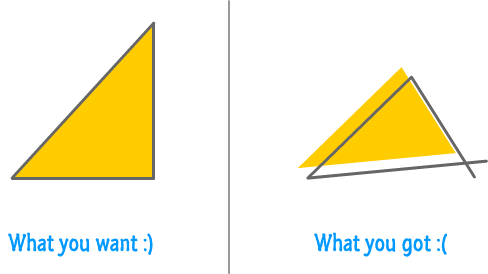
Not to worry, though! In this tutorial, we will take a look at all the deadening steps and how you lot tin can make drawing triangles actually easy...and maybe fifty-fifty fun!
Onwards!
Cursory Intro to Canvass
The canvas element allows you to programatically place pixels on the screen. It does all of this by expecting you to specify unproblematic (and ofttimes ho-hum) draw commands that mimic the path a pen would take on a piece of paper. It's not as boring as I am making it out to be, only it's no episode of Firm of Cards either.
The DOM vs. Canvas article gives y'all meliorate idea of why the canvas does things the manner it does.
Drawing Triangles
First, make sure you have a canvas element defined in your HTML page, and requite it an id of myCanvas. To help y'all out with this, hither is what my HTML looks like:
<!DOCTYPE html> <html> <head> <title>Triangle Canvas Instance</title> </caput> <trunk> <sheet id="myCanvas" width="500" height="500"></canvas> <script> </script> </trunk> </html> In that location isn't much going on here except for the sail element whose id value is myCanvas with a width and elevation of 500 pixels. It is inside this canvass chemical element we will draw our triangle. Now that we got this deadening stuff out of the way...
The way you draw a triangle is by putting into lawmaking the following steps:
- Declare your intent to draw lines and then that the canvas knows what to expect
- Move your virtual pen to to the x and y co-ordinate where you wish to start drawing the triangle
- With your virtual pen at the starting signal, utilise the lineTo method to draw lines between two points.
- Specify the fill color, line color / thickness, etc. to adjust how your triangle looks
These steps are deliberately pretty mitt-wavy to not overwhelm you at this point. The overwhelming volition take identify next, then let's look at the code for drawing a simple rectangle first. Nosotros will weave these four steps in as role of explaining how the lawmaking works.
Within the script tag, add together the post-obit lines of code:
var canvasElement = document.querySelector("#myCanvas"); var context = canvasElement.getContext("2d"); // the triangle context.beginPath(); context.moveTo(100, 100); context.lineTo(100, 300); context.lineTo(300, 300); context.closePath(); // the outline context.lineWidth = x; context.strokeStyle = '#666666'; context.stroke(); // the fill color context.fillStyle = "#FFCC00"; context.fill(); Once you lot've done this, preview your page in your browser. If everything worked out properly, you should run into a yellowish triangle announced:
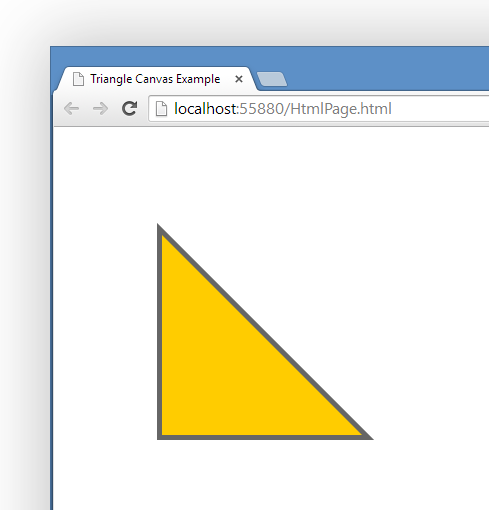
Let'south look at how the lines of code you lot've written map to the triangle that you run across on the screen. Starting at the top...
var canvasElement = certificate.querySelector("#myCanvas"); var context = canvasElement.getContext("second"); These 2 lines are a mainstay at the acme of almost every canvas-related code you volition be dealing with. The showtime line gets a pointer the canvas chemical element in our HTML. The second line gets you access to the sail element'due south context object that allows you to actually draw things into the canvas.
At present, we get to the interesting stuff:
// the triangle context.beginPath(); context.moveTo(100, 100); context.lineTo(100, 300); context.lineTo(300, 300); context.closePath(); Because these lines are crucial to cartoon our triangle, I'1000 going to slow down and dive into greater detail on what each line does.
The get-go line sets it all upwardly:
context.beginPath(); The beginPath method signals to the canvas that you lot intend to draw a path. I know that is a very unsatisfying explanation, only I never said this line of code was deep and full of significant. Information technology volition hopefully make more sense as nosotros wait at the rest of the lines :P
The next line defines where to outset our path from:
context.moveTo(100, 100); That is handled past the moveTo function which takes an ten and y co-ordinate value. In our case, nosotros are going to be starting the path from a horizontal and vertical position of 100:
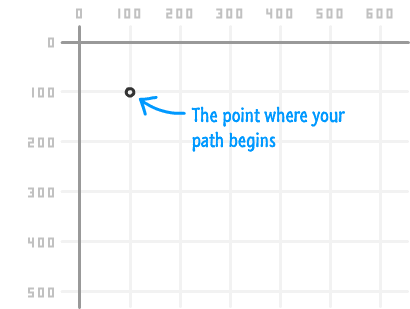
With the starting bespeak set, it's time to beginning drawing the lines that make up our triangle:
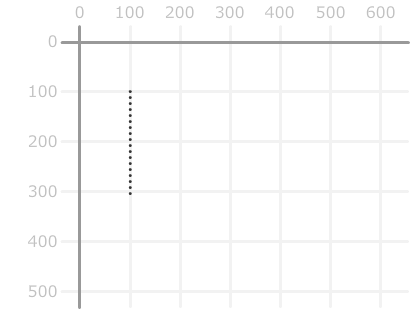
context.lineTo(100, 300); context.lineTo(300, 300); The first lineTo role draws a line from our starting point of (100, 100) to (100, 300):
The second lineTo function picks upward from where the pen currently is and draws a line from (100, 300) to (300, 300):
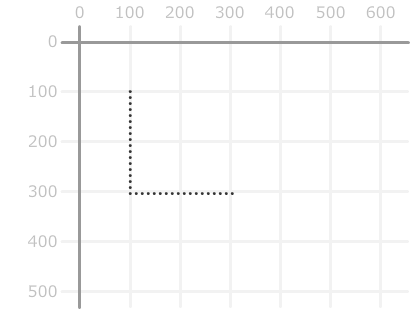
Right now, we have an L shape that isn't quite a triangle. To make this a triangle, we need to close this path by drawing a straight line from where we are dorsum to the beginning. There are ii ways to accomplish this:
- One way is by specifying another lineTo function that looks similar context.lineTo(100, 100). This will draw a line from your current (300, 300) position to (100, 100).
- The other way that you see in our code is by calling context.closePath(). The closePath() method tells your pen to draw a line back to the starting point.
Regardless of which approach you lot take, the end result is that yous will now have a triangle:
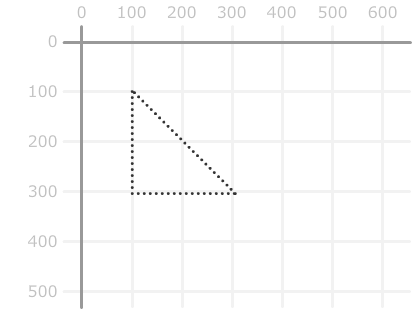
At this bespeak, you may be wondering why our triangle looks dotted and ghostly. If y'all haven't been wondering that, have a few moments and wonder.
Now that you lot are washed wondering, here is why I visualize the lines in the way that I have. The five lines of lawmaking you lot've seen and then far don't actually help you to see the triangle. What you've basically done is describe something that is entirely invisible:
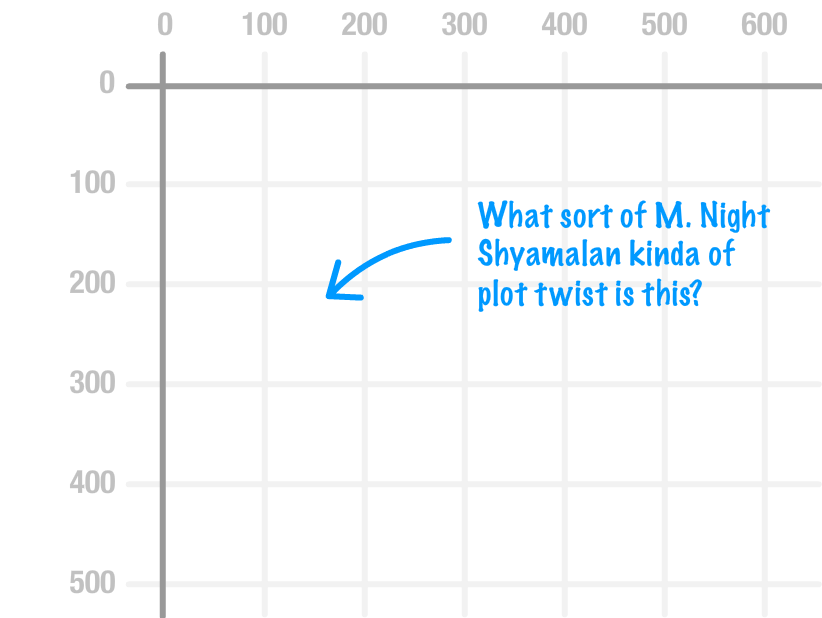
The next two chunks of code prepare that upwardly. The offset chunk is where we define the triangle's outline:
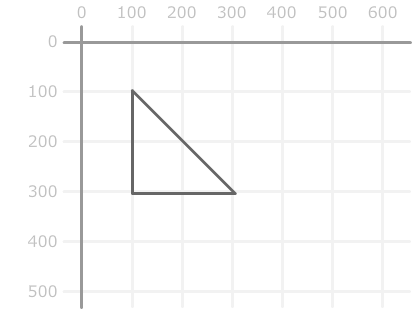
// the outline context.lineWidth = x; context.strokeStyle = '#666666'; context.stroke(); The lineWidth and strokeStyle backdrop specify the thickness and color of the line nosotros want to draw. The actual drawing of the line is handled past calling the stroke method. At this indicate, you will see a triangle whose outlines are really visible:
The second chunk of lawmaking fills our triangle up with a color:
// the fill color context.fillStyle = "#FFCC00"; context.fill(); The fillStyle property allows yous to ascertain the color. The fill method tells your canvas to go alee and fill upward the insides of our closed path with that colour. After this line of code has executed, you will terminate up with the triangle in its final form:
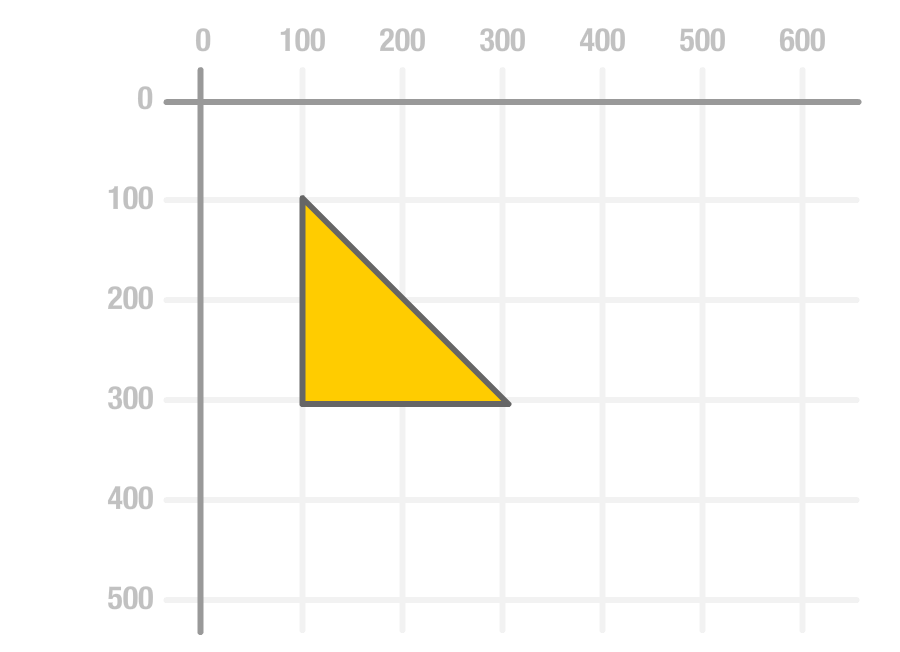
Yous now take a triangle that has an outline and a make full. It is, every bit some wise people say, complete.
Drawing Equilateral Triangles
Before nosotros call it a mean solar day, in that location is ane last thing we want to look at. That has to do with the popular equilateral triangles you may want to describe where all sides are the same length:
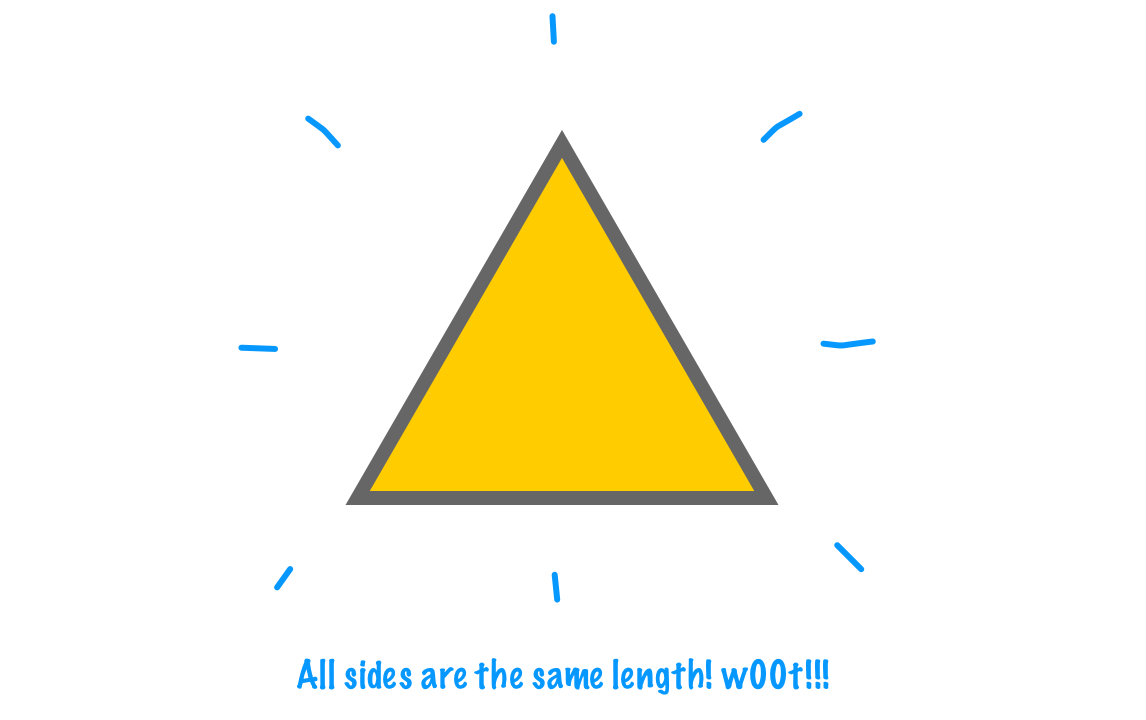
It turns out that creating them is a bit of a doozy, merely we'll un-doozify this here. The claiming lies in figuring out the iii points that volition brand upwards the triangle. Permit'southward say that this is the triangle we desire to describe:
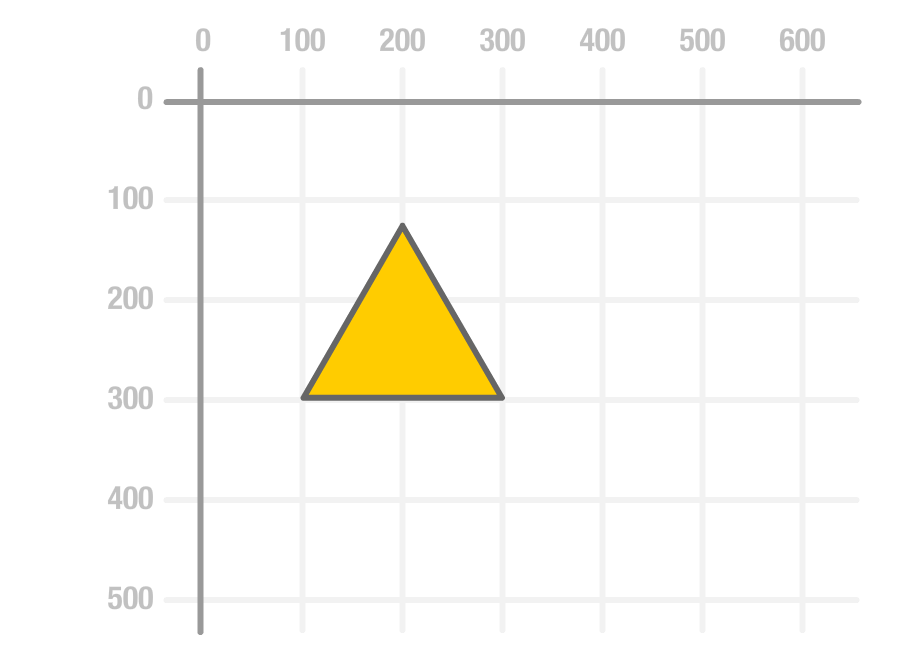
For the 3 points, two of the points are part of a straight line that makes up ane of the sides. These two points would be (100, 300) and (300, 300). The catchy part is the tertiary signal:
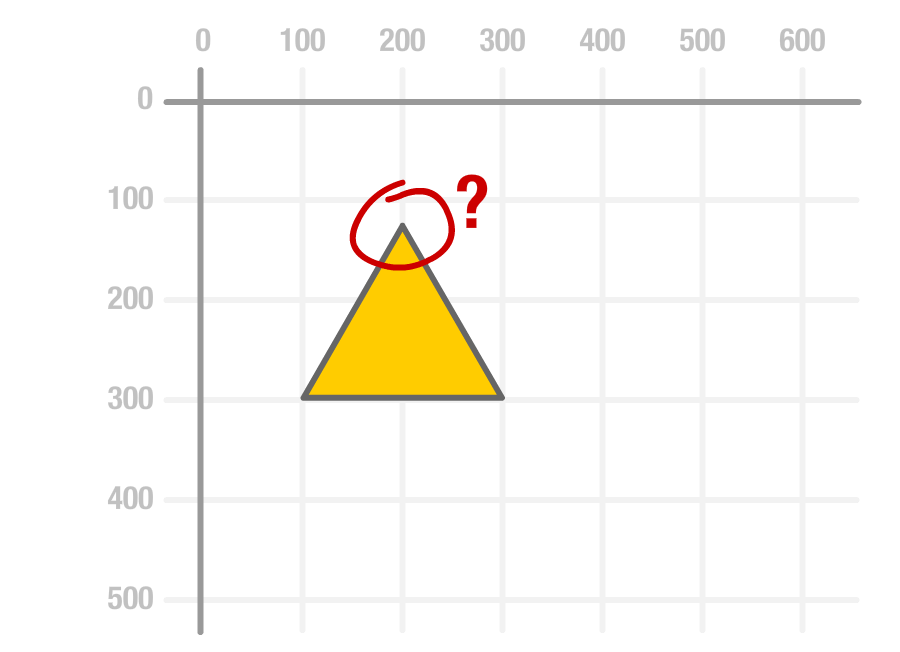
The third point'southward horizontal position is half the length of our triangle'southward side. That would be one half of 200 which is 100. Since the triangle is kickoff horizontally by 100 pixels, the final horizontal position volition exist 200:
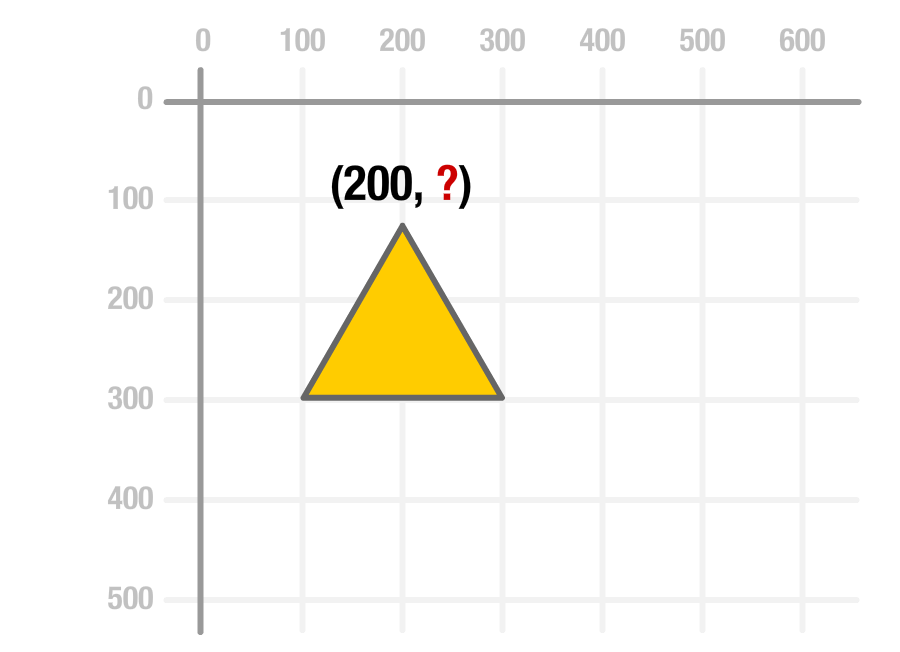
The vertical position is less straightforward to figure out. This position involves both the outset likewise equally this triangle'southward height. The outset is straightforward to calculate, for we are starting 300 pixels from the top. The acme is the catchy i. The verbal math involved in figuring the height is something nosotros'll encompass separately, but the formula is length * Math.cos(30) in the degrees world or length * Math.cos(π / 6) in the radians i.
If we put all of this together into working code, here is what the full lawmaking for cartoon our equilateral triangle will expect like:
let canvas = document.querySelector("#myCanvas"); let context = sheet.getContext("2nd"); function drawTriangle() { context.clearRect(0, 0, sail.width, canvas.top); context.fillStyle = "#FFFFFF"; context.fillRect(0, 0, canvass.width, sail.height); let height = 200 * Math.cos(Math.PI / 6); context.beginPath(); context.moveTo(100, 300); context.lineTo(300, 300); context.lineTo(200, 300 - acme); context.closePath(); // the outline context.lineWidth = 10; context.strokeStyle = '#666666'; context.stroke(); // the fill colour context.fillStyle = "#FFCC00"; context.make full(); } drawTriangle(); The of import part is the lawmaking that makes upward our 3 points:
allow height = 200 * Math.cos(Math.PI / 6); context.beginPath(); context.moveTo(100, 300); context.lineTo(300, 300); context.lineTo(200, 300 - height); context.closePath(); Observe that we translated what nosotros talked about using words into the moveTo and lineTo calls that our canvas knows what to do with.
Decision
Anyhow, as you tin meet, cartoon a triangle isn't particularly hard. At least, it should no longer be after seeing how easy it is to draw a few lines and fix a few visual backdrop. Information technology just requires you keeping track of where your virtual pen is at the end of a serial of moveTo, lineTo, and closePath commands.
Got a question or just want to chat? Comment beneath or driblet by our forums (they are actually the same thing!) where a agglomeration of the friendliest people yous'll e'er run into will be happy to help you out!


When Kirupa isn't busy writing about himself in 3rd person, he is practicing social distancing…fifty-fifty on his Twitter, Facebook, and LinkedIn profiles.
Striking Subscribe to go cool tips, tricks, selfies, and more personally mitt-delivered to your inbox.

Source: https://www.kirupa.com/html5/drawing_triangles_on_the_canvas.htm
Posted by: childresswalbra1935.blogspot.com
0 Response to "How To Draw Triangle With Given Points C++"
Post a Comment